
What Is an IHC Stainer and How Does It Work?
Modern pathology labs use the immunohistochemical staining machine (IHC Stainer) as its main automated tool to correctly process tissue samples for visual protein detection. The 2023 Global Pathological Equipment Market Report estimates that every IHC staining machine can process about 40 sections per hour. This is 30 times faster than doing it by hand, which takes 15 hours to do the same amount of work. It also makes 15% fewer mistakes than doing it by hand, which is a 2% staining error rate. According to clinical statistics from the American Cancer Society, the ihc stainer's standardized procedure has lowered the false negative rate of HER2 testing for breast cancer by 18%, therefore directly influencing the course of targeted therapy for individuals. This category of equipment costs between 1.2 million and 5 million RMB. However, the payback time on investment is typically shorter than 24 months if labor expenses are lowered (from 150 yuan to 50 yuan per sample) and the chance of repeated testing because of technical mistakes is reduced (expected to be reduced by 90%).
Its technical foundation is based on the coordinated action of the temperature control module and the precision fluid control system. Consider the Roche Ventana BenchMark series, for instance. The instrument internally holds eight to thirty-two autonomous reagent slots with a capacity ranging from one to fifty ml. The temperature control precision attains 0.5C (in the antigen retrieval phase, a high temperature of 95C to 100C has to be kept). The pipetting accuracy error of the robotic arm was less than 0.5l (as required by the ISO 15189 standard), and the antibody incubation time error was kept within 5 seconds per 60-minute cycle to ensure a 5% CV value (coefficient of variation) of staining intensity. A 2024 study in the Journal of Clinical Pathology found that the consistency of results among different operators was 98%, much better than the 75% median value for manual operation when ihc stainer was utilized for PD-L1 detection.
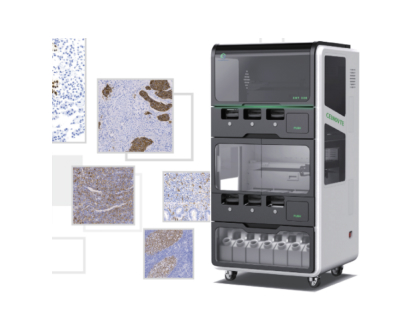 The workflow includes 12 automated steps such dewaxing, antigen retrieval, blocking, and incubation of primary and secondary antibodies. The key innovation is the "Heat-induced Antigen Retrieval" (HIER) technology, which can raise the temperature from 25C to 95C within 2 minutes (with a temperature change rate of 0.58C per second) and maintain the high temperature for 20 minutes to unmask the antigen epitopes. Intelligent algorithms optimize reagent consumption. With an MTBF (Mean Time Between Failures) exceeding 3,000 hours, the average annual failure rate of modular designed equipment is less than 1.5 times. Through the remote diagnosis system, 95% of software issues can be fixed in under two hours.
The clinical advantages are seen in the breakthrough enhancement of detection speed and accuracy. The 2024 Mayo Clinic case study reveals that the MSI testing cycle for colorectal cancer samples processed using automated staining machines is shortened from 72 hours to 4 hours, and the positive detection rate rises by 12%. In the ALK gene testing for lung cancer, the totally automated platform maintains the false positive rate below 0.8% (the average for manual operation is 3.2%), therefore avoiding around 2.4 million US dollars in misdiagnosis compensation risks for medical institutions each year. Promoting a qualitative leap in precision medicine, the newest models like Leica BOND-III have included an artificial intelligence image analysis system that can automatically detect staining intensity and produce an H-Score with 99.2% accuracy.
The workflow includes 12 automated steps such dewaxing, antigen retrieval, blocking, and incubation of primary and secondary antibodies. The key innovation is the "Heat-induced Antigen Retrieval" (HIER) technology, which can raise the temperature from 25C to 95C within 2 minutes (with a temperature change rate of 0.58C per second) and maintain the high temperature for 20 minutes to unmask the antigen epitopes. Intelligent algorithms optimize reagent consumption. With an MTBF (Mean Time Between Failures) exceeding 3,000 hours, the average annual failure rate of modular designed equipment is less than 1.5 times. Through the remote diagnosis system, 95% of software issues can be fixed in under two hours.
The clinical advantages are seen in the breakthrough enhancement of detection speed and accuracy. The 2024 Mayo Clinic case study reveals that the MSI testing cycle for colorectal cancer samples processed using automated staining machines is shortened from 72 hours to 4 hours, and the positive detection rate rises by 12%. In the ALK gene testing for lung cancer, the totally automated platform maintains the false positive rate below 0.8% (the average for manual operation is 3.2%), therefore avoiding around 2.4 million US dollars in misdiagnosis compensation risks for medical institutions each year. Promoting a qualitative leap in precision medicine, the newest models like Leica BOND-III have included an artificial intelligence image analysis system that can automatically detect staining intensity and produce an H-Score with 99.2% accuracy.
The workflow includes 12 automated steps such dewaxing, antigen retrieval, blocking, and incubation of primary and secondary antibodies. The key innovation is the "Heat-induced Antigen Retrieval" (HIER) technology, which can raise the temperature from 25C to 95C within 2 minutes (with a temperature change rate of 0.58C per second) and maintain the high temperature for 20 minutes to unmask the antigen epitopes. Intelligent algorithms optimize reagent consumption. With an MTBF (Mean Time Between Failures) exceeding 3,000 hours, the average annual failure rate of modular designed equipment is less than 1.5 times. Through the remote diagnosis system, 95% of software issues can be fixed in under two hours.
The clinical advantages are seen in the breakthrough enhancement of detection speed and accuracy. The 2024 Mayo Clinic case study reveals that the MSI testing cycle for colorectal cancer samples processed using automated staining machines is shortened from 72 hours to 4 hours, and the positive detection rate rises by 12%. In the ALK gene testing for lung cancer, the totally automated platform maintains the false positive rate below 0.8% (the average for manual operation is 3.2%), therefore avoiding around 2.4 million US dollars in misdiagnosis compensation risks for medical institutions each year. Promoting a qualitative leap in precision medicine, the newest models like Leica BOND-III have included an artificial intelligence image analysis system that can automatically detect staining intensity and produce an H-Score with 99.2% accuracy.
Compartir · Twitter · Discord