
Leaving Solo Mining: What a Pool Account Actually Changes
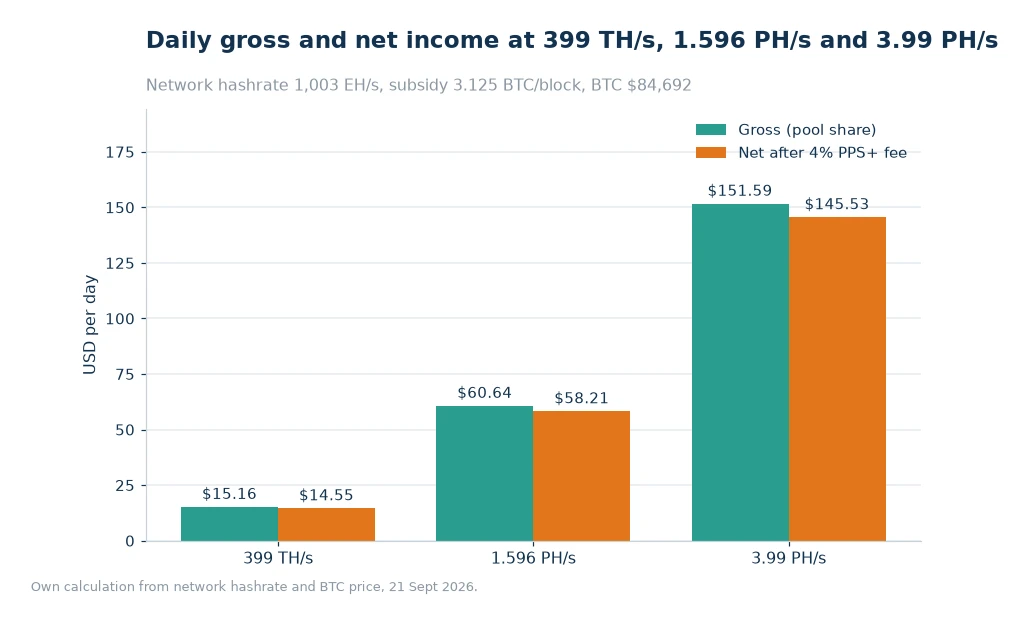
Solo mining is a lottery with a very long ticket, and most home setups never see the draw. At 399 TH/s the whole network would pay 0.00017899 BTC a day on average, about $15.16 gross, yet a solo miner might wait years between blocks. Joining a pool trades that rare full reward for a small, steady share of every block the group finds.

Key takeaways
- At 399 TH/s, pool mining credits roughly 0.00017899 BTC a day, or $15.16 gross and $14.55 net.
- A solo miner at the same hashrate keeps the full block when one arrives, but the gap between blocks can run for years.
- PPS+ settles the block-reward component hourly against current difficulty, so the income curve is smooth.
- PPLNS pays after 6 confirmations over a 5-round difficulty window, which suits operators who can wait.
What solo mining optimises for, and what it costs
A solo miner is running a business with one customer and an unpredictable delivery date. When a block is found, the reward is large and entirely theirs. Between finds, the electricity meter keeps turning and nothing arrives. At 399 TH/s the expected interval is measured in years, not weeks, which means the household budget is funding a machine that may never produce a coin in the time the owner keeps it.
That is not irrational if the point is the experiment rather than the income. Some operators enjoy running a full node and pointing a single machine at it. The trouble starts when the same setup is expected to cover its power bill. A pool converts an all-or-nothing outcome into a series of small payments, and for most home miners that change is the difference between a hobby with a bill and an operation with a revenue line.
Shares become the unit of account
Once you join a pool, the thing you produce stops being blocks and becomes shares. A share is a proof that your machine did a chunk of hashing work, and it is counted whether or not the pool finds a block in that moment. The pool adds up shares across all members and divides the reward according to the rules of the chosen scheme. Your hashrate still matters, but it now expresses itself as a percentage of a group rather than as a chance of a solo hit.
This is also why a pool account is easier to reason about. Two miners with the same hashrate earn nearly the same amount over a month, regardless of who happened to be online when a block landed. Joining the ViaBTC Mining Pool means accepting that smoothing in exchange for giving up the tail chance of a full reward. For a machine that needs to justify its power draw, smoothing is usually the more useful property.
The hourly rhythm of a PPS+ account
PPS+ is the default scheme, and its most noticeable feature is timing. The block-reward portion is settled hourly against the difficulty in force at the time, so the credit appears in a pattern rather than in a lump after a lucky find. The listed fee on that component is 4%. The transaction-fee portion follows a separate PPLNS-style arrangement with a listed 2% rate, which is why the two components should never be added into a single 6% figure.
Hourly settlement changes how an operator plans. A power bill arrives monthly, a fan fails without warning, and a repair needs paying this week. A daily or hourly credit stream can absorb those events without a cash-flow cliff. It also makes the effect of a difficulty change visible quickly: the hourly credit moves, and the operator can respond before a month of statements has piled up.
Address, worker name and the first day
The setup itself is short. Create the account, choose the coin, generate or paste a payout address, and configure the machine with the pool's stratum endpoint and a worker name. The worker name is worth thinking about for more than a minute: a naming convention that includes the site and the machine number will save hours later when one unit misbehaves and you need to find it among a list of identical rows.
Run the first day without changing anything. Watch the reported hashrate on the machine and the accepted share count on the pool dashboard. They should agree within normal variance. If the machine reports full output and the pool sees nothing, the problem is usually a typo in the worker name, a firewall, or a payout address on the wrong network. Fix those before scaling up, because a second machine configured the same wrong way doubles the confusion.
Luck moves off your books
Pool luck is the gap between the blocks a pool expects to find and the blocks it actually finds in a window. Under PPS+, that variability is carried by the pool rather than by the individual miner, which is precisely what the higher listed rate on the block-reward component compensates. Under PPLNS, the miner carries more of it, and the listed rate on the combined reward is 2%.
The trade is not a free lunch in either direction. PPS+ offers a predictable stream at a listed 4% on the block-reward component. PPLNS offers a lower listed rate with more movement and a longer settlement tail. An operator with a thin power margin may prefer the first; one with reserves and a long horizon may prefer the second. Neither choice changes the underlying network arithmetic, only the shape and timing of the payment.
Switching costs that are not money
The invoice is the visible cost of changing pools; attention is the hidden one. A new dashboard, a new worker naming habit and a new payout schedule all take a few days to learn. There is also a gap between the last credit at the old pool and the first at the new one, which can look alarming if the old balance was not withdrawn first. Clear the old balance and confirm the address before pointing the machines elsewhere.
The table below puts the three common hashrate tiers into the terms a solo miner actually cares about: how long the network would take, on average, to produce a given amount of BTC. The comparison makes the smoothing argument concrete.
| Hashrate | Days to 0.001 BTC | Days to 0.01 BTC | Net per day |
|---|---|---|---|
| 399 TH/s | 5.6 | 55.9 | $14.55 |
| 1.596 PH/s | 1.4 | 14.0 | $58.21 |
| 3.99 PH/s | 0.6 | 5.6 | $145.53 |
Worked example
Use the 399 TH/s case to see where the daily credit comes from and how quickly it accumulates.
- Network daily issuance: 3.125 BTC × 144 blocks = 450 BTC.
- One terahash of network capacity therefore maps to 450 ÷ 1,003,100,000 = 0.00000044861 BTC.
- 399 × 0.00000044861 = 0.00017899 BTC a day.
- 0.00017899 × 84,692 = $15.16 gross.
- Listed 4% on the block-reward component: $15.16 × 0.04 = $0.61, leaving $14.55 net.
- Time to 0.001 BTC: 0.001 ÷ 0.00017899 = 5.59 days.
- Time to 0.01 BTC: 0.01 ÷ 0.00017899 = 55.87 days.
- At 3,990 TH/s the daily figure is 0.00178994 BTC, so 0.01 BTC takes 0.01 ÷ 0.00178994 = 5.59 days.
Frequently asked questions
Does a pool take the whole block reward?
No. Under PPS+ the pool credits your share of the block-reward component hourly and applies a listed 4% rate to that component, while transaction fees follow a separate arrangement at a listed 2%.
Will I earn the same every day?
Not exactly. PPS+ smooths the block-reward component against current difficulty, but difficulty and coin price still move, and the transaction-fee portion varies with network activity.
Can I go back to solo mining later?
Yes. Your hardware and payout address remain yours, so you can point the machine at a solo node whenever you choose; withdraw any pool balance first and expect a short gap in credits during the move.
Give the new account a month before judging it
One week is too short to compare pool income, because difficulty and coin price drift and the first days include setup noise. Run a full month, export the daily credits, and compare the total with the network arithmetic at your hashrate. If the two agree within normal variance, the account is doing what it should. The fee page explains the split between the two components, and the multi-currency wallet keeps the proceeds in the same account as the mining dashboard.
Sources: ViaBTC pool, pricing and wallet pages, consulted for the settlement rules and component rates. The chain inputs used here were read on 21 Sept 2026: 1,003 EH/s network hashrate, 132.76 T difficulty, 3.125 BTC subsidy, 144 blocks daily and $84,692 per BTC. This article was published 24 Oct 2026, and target times are averages that assume the rig never stops[1].