
Private Label Perfume QC: Checkpoints for a Spa or Hotel Amenity Line
A spa or hotel amenity line fails when the second batch does not smell like the first. Private label production concentrates that risk: the brand controls the label and the service, the factory controls the formula, the filling and the records, and the guest experience lives in the hand-off. Put the QC checkpoints on the contract side of that hand-off, fill tolerances, batch records, retained samples, and the line stays consistent across properties and reorders.
Key takeaways
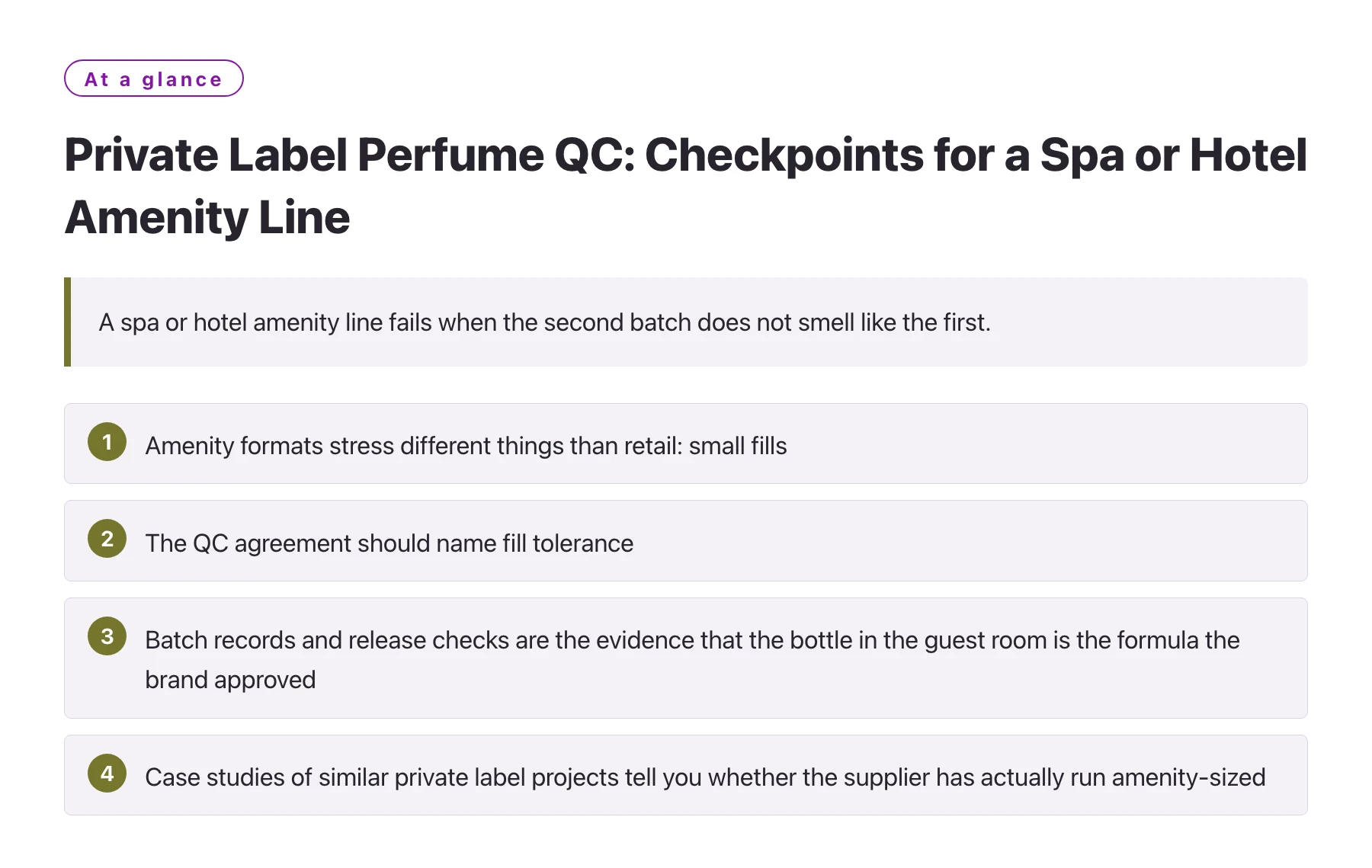
- Amenity formats stress different things than retail: small fills, high turnover and a scent that must be identical across rooms, hotels and reorders.
- The QC agreement should name fill tolerance, batch release and retained samples, because amenity consistency is a documented promise, not a hope.
- Batch records and release checks are the evidence that the bottle in the guest room is the formula the brand approved, in the correct quantity and concentration.
- Case studies of similar private label projects tell you whether the supplier has actually run amenity-sized, amenity-paced orders before.
There is a specific way amenity fragrance lines fail in hospitality. The first order is perfect; the reorder, produced months later from a slightly different concentrate batch and a different fill slot, is close but not the same, and in a hotel room close means a complaint.
This article is a QC checklist written for the buyer side: which checkpoints belong in the private label agreement, what each one is for, and how to verify the supplier's process on a trial order before the line goes into rooms.
Why amenity formats change the QC conversation
Retail perfume is bought in a considered moment; amenity fragrance is experienced in a space, usually without a purchase decision attached. That shifts the quality bar from attractive to reliable: the scent, the fill level and the pump performance have to be right every time, in every room, across sites that may be thousands of kilometres apart.
Small formats also make the fill and the pump matter more per millilitre. A fill tolerance that is invisible in a 50 ml bottle is a visible difference in a 10 ml amenity bottle, and a cap or pump that misbehaves on one production line can surface as hundreds of guest complaints.
The checkpoints a private label agreement should name
| Checkpoint | What it protects | Where it is verified |
|---|---|---|
| Concentrate specification | The scent in the bottle matches the approved reference | Formula file and retained concentrate sample |
| Fill weight tolerance | Guests do not receive visibly short bottles | Filling line records and random checks |
| Batch release | Only released batches ship to properties | Release check on the batch record |
| Stability and conditioning | The product survives storage and travel time | Stability report and expiry guidance |
| Retained samples | Disputes have a physical reference | Sealed samples held by both parties |
Every row should be in the agreement as a named tolerance or a named document. If it only exists in the sales conversation, it is not in the QC system.
Tests and records, not just samples
Sampling decides whether a product can be approved; records decide whether it can be repeated. Ask the supplier to run the finished product through its testing and release procedure and to keep the result in the batch file, so every property order can be traced to a released batch [1].
For an amenity line, add one repeatability test of your own: order the same SKU twice with a gap between productions and compare the retained samples side by side. The difference between the two samples is the real specification of the supplier's process.
Before you sign, Learn more about how the manufacturer structures private label production, then test those claims with the trial order described below.
Running the trial order as a QC rehearsal
- Order the real SKUStart the partnership with the amenity format you will actually sell, not a larger bottle that is easier to fill.
- Demand the batch recordAsk for the full record for the trial batch, from raw material to release, and read it.
- Hold the retained sampleKeep a sealed sample of the trial batch and name it in the agreement as the reference for later comparisons.
- Reorder oncePlace a second small order and compare the samples; this is the cheapest possible test of consistency.
Evidence of repeatability: case studies and reference projects
A supplier promising consistency should be able to point to projects with the same shape, private label lines produced repeatedly over time. Reading examples of fragrance projects on a manufacturer's site tells you what kind of repeat business they are used to, which is a better predictor for an amenity line than a single impressive product photo.
When the process evidence lines up and the trial orders repeat cleanly, the partnership can move to scale. Keep the same QC framework, retained samples, batch records and release checks, for every new scent the hotel adds between seasons.
Sources
- SGS: Cosmetics, Personal Care & Household Testing —— Testing, inspection and certification services for cosmetics and personal care, including microbiological, stability and safety testing aligned with cosmetics GMP.
Frequently asked questions
Why does an amenity line need stricter QC than a retail launch?
Amenity products are consumed in bulk across many properties, so an error repeats at scale and reaches guests who did not choose the brand. Consistency, not wow, is the product.
What is a retained sample and why keep one?
A sealed physical sample from the approved or released batch, labelled with date, batch number and reference. It is the physical basis for comparing reorders and resolving disputes about scent or fill.
How do I compare two batches of the same perfume?
Side by side, on fresh blotters, from sealed samples of both batches, at the same time of day and in the same room. The comparison should include fill level and pump behaviour, not just the scent.
Can a hotel brand change the scent between seasons with the same supplier?
Usually yes, if the private label agreement covers multiple references. Keep the QC framework identical across scent changes so the system does not have to be rebuilt.
What should the first amenity order prove?
That the batch record appears without prompting, the fill tolerance is real, and the reorder matches the first sample. If the first order proves those three, the line can scale; if not, a larger order will not fix it.